
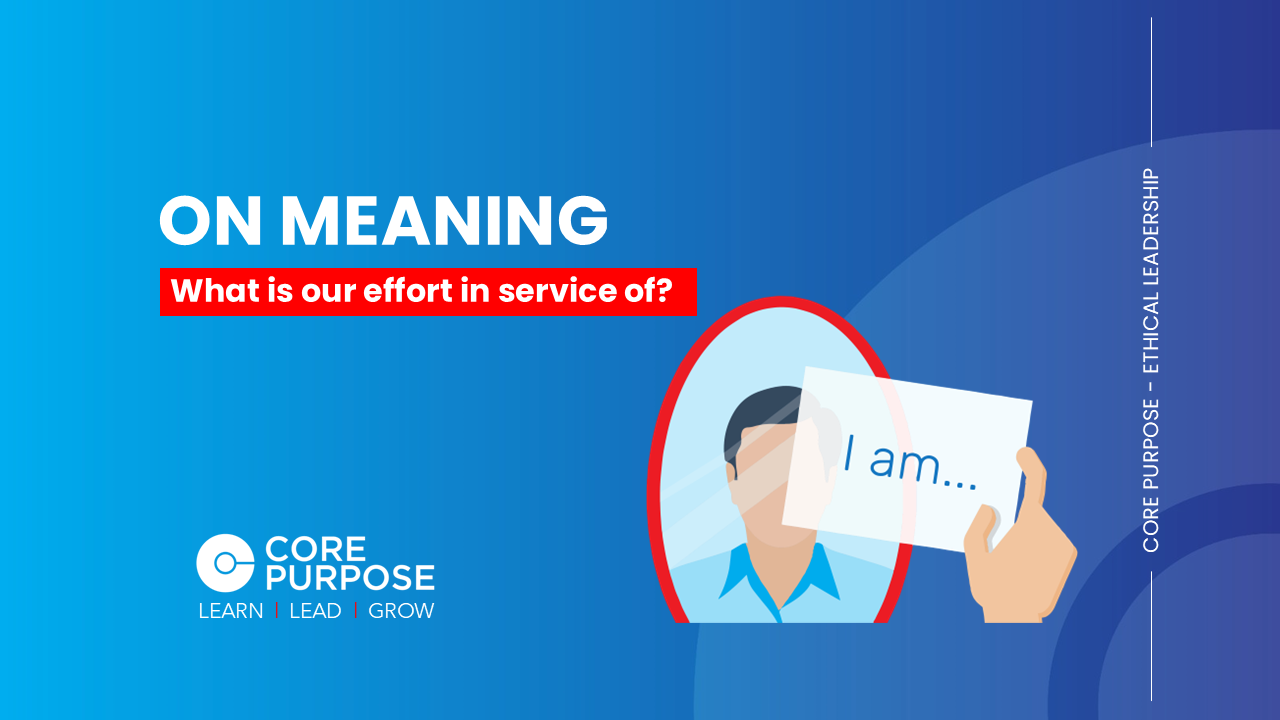
What our effort is in service of?
Another December, another new year to come. Some things were achieved. Some things are carried. And some questions never left. One of them is about meaning.
This reflection is an invitation to pause with that question and notice what it stirs.
Another year has passed and I find myself less interested in what was achieved, and more curious about what it all meant for me, and for those whose lives I have touched.
Meaning is a quiet thing, isn’t it? It can be as abstract or as concrete as love. It doesn’t announce itself with milestones or metrics and it doesn’t sit neatly inside systems or plans. We feel its movement. When it’s present, we feel steadier, when it’s missing, no amount of action quite compensates for it.
We rarely talk about meaning directly, especially in leadership contexts. Perhaps because it feels too personal, too abstract, or too difficult to define and yet, meaning is vital. Most leaders I work with can tell immediately when something no longer feels meaningful. The work may still be important; the outcomes may still matter. But something inside them has gone quiet. Uncomfortably quiet.
Meaning shows up in simple, unglamorous ways, in whether our effort feels justified, in whether decisions sit well with us once the noise dies down, in whether we can still recognise ourselves in the roles we occupy. Are we still there?
It’s surprisingly easy to lose touch with meaning without realising it. Life gets too full, responsibilities multiply, expectations increase, we adapt, we respond, we deliver. We keep going, like a clock, competently, sometimes admirably, while slowly drifting away from the original sense of why. I know that some of you know exactly what I mean.
Most leaders, these days, are expected to move forward even when clarity is incomplete, to provide reassurance while holding uncertainty, to absorb pressure without showing too much of it. Over time, the focus can narrow and shift towards what needs to be done next, rather than what the effort is ultimately in service of.
Busyness and ambition are not the problem. The real risk is continuing on while slowly losing contact with ourselves. All seem to become transactional – but what do we actually trade?
Meaning (much like love) isn’t something we “have” once and keep forever. It needs attention, it needs honesty and sometimes, it needs us to slow down enough to notice when we’re continuing out of habit rather than genuine desire to contribute.
Meaning always remains personal. We can create, borrow and adapt systems, frameworks, and cultures, but we cannot borrow alignment. At some point, every leader might benefit from slowing down to notice whether their energy is still going toward what genuinely matters to them professionally, ethically, and personally.
As the calendar reminds us that another year has gone by, there’s a natural temptation to summarise, evaluate, and ask what worked and what didn’t. Those questions have their place. But alongside them, there’s another set of questions worth sitting with quietly:
- What felt worth the effort this year?
- Where did my attention feel well placed?
- Where and when did I feel drained?
- What responsibilities did I take on with integrity, even when they were difficult?
- And where might I have stayed busy to avoid a harder question??
These questions help us recalibrate not just what we do, but how we stand in what we do.
Meaning doesn’t arrive with certainty. More often, it returns through responsibility, through choosing again, consciously, what deserves our time, care, and courage. It shows up when we act in ways that are aligned, even when that alignment costs us something.
As we step toward a new year, perhaps the most useful thing we can do as leaders is not to rush toward what’s next, but to pause long enough to remember what matters.
Quietly and honestly.
Because leadership grounded in meaning doesn’t need to prove itself.
It simply holds.
Camelia
P.S. This reflection also sits at the heart of a small-group programme, Lead Yourself First, designed for professionals who want to reconnect with clarity, alignment, and ethical self-leadership before leading others.
You’re welcome to register your interest for early access and updates.
We guide individuals and organisations to draw on the humanities, on the social sciences, and on the moral fabric of their leaders and employees to build moral capacity and thus reduce vulnerability.
Stay in the loop!
Join our mailing list to receive the latest news and updates from our team.
We hate SPAM too. You can unsubscribe from our list for any reason.
